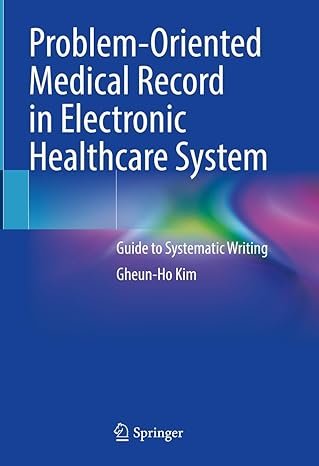
Problem-Oriented Medical Record in Electronic Healthcare System: Guide to Systematic Writing
In the modern era of electronic health records (EHRs), accurate and systematic documentation has become one of the most essential skills for medical students, physicians, and healthcare professionals. Problem-Oriented Medical Record in Electronic Healthcare System: Guide to Systematic Writing is a practical and comprehensive guide that teaches the principles of problem-oriented medical records (POMR) and their application in electronic systems. Now available at Books Hub PK, this book is the perfect tool to master structured clinical documentation.
The problem-oriented medical record (POMR), introduced by Dr. Lawrence Weed, revolutionized medical record keeping by promoting a systematic approach to patient care. This book brings those principles into the digital age, guiding healthcare professionals to effectively organize, analyze, and document patient encounters in electronic healthcare systems.
Key Features of Problem-Oriented Medical Record in Electronic Healthcare System:
-
Explains the concept, structure, and advantages of POMR in modern medicine.
-
Step-by-step guide to systematic documentation in electronic medical records.
-
Covers SOAP notes (Subjective, Objective, Assessment, Plan) for accurate clinical entries.
-
Demonstrates how POMR improves continuity of care, communication, and patient safety.
-
Includes practical examples, templates, and case-based scenarios for learners.
-
Essential for medical students, residents, physicians, nurses, and healthcare administrators.
-
Supports exam preparation, clinical training, and professional record-keeping.
For medical students and junior doctors in Pakistan, this book provides a clear framework for writing professional medical records, ensuring that patient notes are well-structured, legally sound, and clinically useful. For practicing doctors, it offers insights into improving efficiency and accuracy in electronic documentation, a skill that is increasingly in demand in hospitals worldwide.