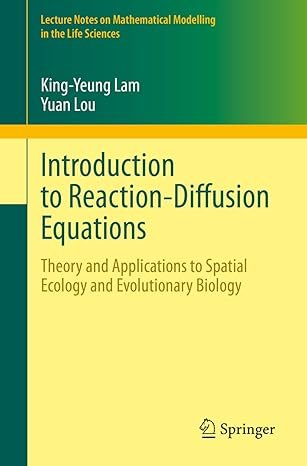
Introduction to Reaction-Diffusion Equations: Theory and Applications to Spatial Ecology and Evolutionary Biology (Lecture Notes on Mathematical Modelling in the Life Sciences)
Introduction to Reaction-Diffusion Equations: Theory and Applications to Spatial Ecology and Evolutionary Biology is a comprehensive and modern guide that explores how mathematical modeling and partial differential equations (PDEs) describe real-world biological and ecological phenomena. This book presents an accessible yet rigorous introduction to reaction-diffusion systems, explaining how they can be used to model population dynamics, pattern formation, species interaction, and evolutionary processes across space and time.
Part of the renowned Lecture Notes on Mathematical Modelling in the Life Sciences series, this book serves as an essential reference for students and researchers at the intersection of mathematics, ecology, and theoretical biology. It skillfully combines theoretical derivations, applied case studies, and computational simulations, helping readers understand how local reactions and diffusion mechanisms shape complex biological patterns observed in nature.
Key Features:
-
Comprehensive Theoretical Foundation: Provides a step-by-step introduction to reaction-diffusion equations, covering both linear and nonlinear models, stability analysis, and wave propagation.
-
Applied Focus: Demonstrates how mathematical principles translate into real-world biological systems, including population dispersal, predator-prey dynamics, epidemic spread, and genetic evolution.
-
Interdisciplinary Approach: Bridges mathematics, physics, ecology, and evolutionary biology, showing how spatial processes drive ecological and evolutionary patterns.
-
Illustrative Examples and Simulations: Features numerous figures, computational results, and case studies that visualize complex spatial behaviors.
-
Accessible Yet Rigorous: Written in clear language suitable for graduate students and researchers, with detailed explanations of key mathematical methods and modeling techniques.
-
Research-Oriented Insights: Includes discussions of current trends, such as pattern formation, Turing instability, and eco-evolutionary dynamics.
-
Pedagogical Structure: Each chapter includes worked examples, exercises, and summary points to strengthen conceptual understanding and analytical skills.